
Best Fragrance for Women in 2026 — The Complete Guide to Finding Your Perfect Scent
Finding the best fragrance for women is one of the...
Read More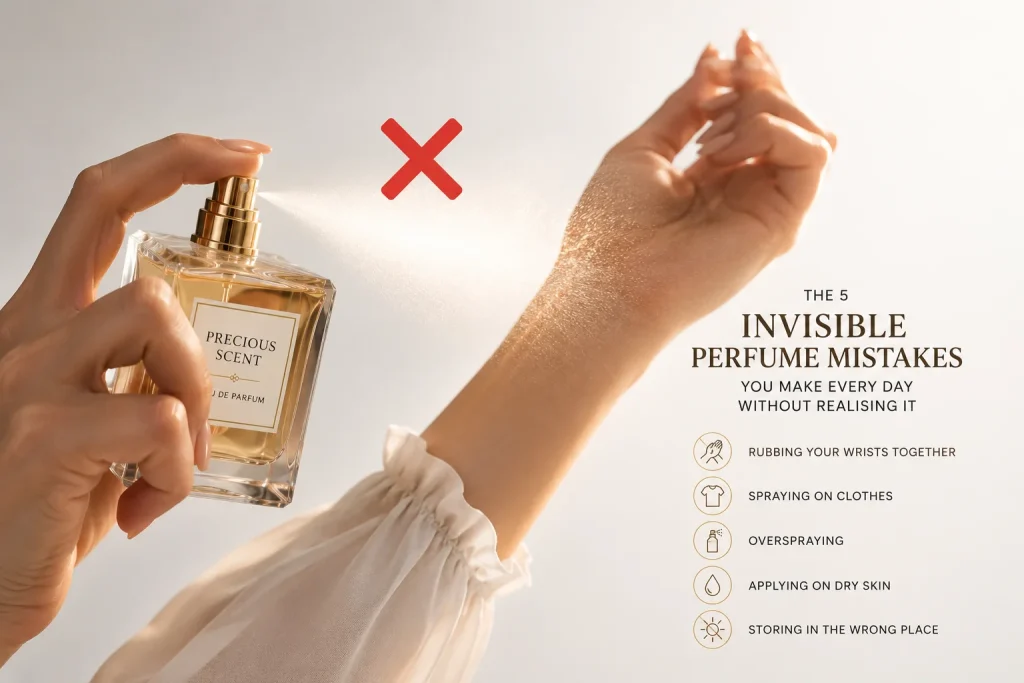
Here is the thing about perfume mistakes. The obvious ones — buying a fake, spraying too much, storing it in direct sunlight — most people already know about and avoid. The mistakes that are actually costing you are quieter than that. They happen in the first thirty seconds of your morning. They happen in habits so automatic you stopped noticing them years ago. They are invisible, which is exactly why they persist.
These five mistakes are made by the vast majority of people who wear fragrance every single day. Smart people. People who genuinely love fragrance. People who have spent real money on good bottles and cannot understand why the results are consistently underwhelming.
After reading this, none of them will be invisible to you anymore.
This is the mistake that costs people the most money and generates the most fragrance disappointment — and it happens before you have even bought the bottle.
You walk into a store. You smell a fragrance on a strip, or directly from the bottle, or in the first thirty seconds on your wrist. You make a decision based on that initial impression. You buy the bottle. You get home, you spray it on, you live with it for a day — and something is off. It does not smell the way you remember. It is not what you thought you were buying.
What happened is simple and completely avoidable: you evaluated the wrong phase of the fragrance.
Every fragrance has three phases. Top notes are what you smell in the first five to fifteen minutes — bright, volatile, immediate molecules designed to create an attractive first impression. They are not the fragrance. They are the introduction. Heart notes emerge after the top notes fade and define the character of the scent. Base notes are the foundation — the heavy, lasting molecules that stay on your skin for hours and represent what you will actually be wearing all day long.
In 2026, the most sophisticated fragrance buyers no longer make decisions based on the opening. They spray on skin, leave the store, go for a coffee, run an errand — and smell their wrist twenty to thirty minutes later. What they smell at that point is the real fragrance. That is the base note development on their specific skin, in their specific body temperature, interacting with their specific chemistry. That is what they are buying.
The correction is simply patience. Test on skin. Wait. Evaluate the dry-down. This single change in how you test fragrance will save you from more bad purchases than any other piece of advice on this list.
People choose an outfit based on where they are going and what they are doing. They choose shoes based on the terrain. They match almost every other element of their presentation to the context of their day — except their fragrance, which they spray on automatic without a second thought every single morning.
This matters more than most people realise. Fragrance is not just an accessory. It is a communication. It signals something to the people around you and, more importantly, to yourself. And wearing the same fragrance to a quiet morning working from home, an important professional meeting, a family dinner, and a late-night social occasion is the olfactory equivalent of wearing the same outfit to all four.
The fragrance world is shifting decisively toward this understanding. People want scent to reflect who they are and how they feel — not just what smells pleasant. In 2026, luxury fragrance is less about labels and more about meaning. More people now own multiple fragrances with a clear purpose — one for work, one for evenings, one for the gym, one for comfort at home. Fragrance is being treated like fashion — contextual, flexible and mood-led.
This does not require a large or expensive collection. It requires two or three deliberately chosen bottles assigned to specific contexts. A clean, professional fragrance for your working hours. A richer, warmer fragrance for your evenings. Perhaps a relaxed, informal scent for your weekends and days off. These three bottles, rotated with intention rather than habit, produce a consistently better fragrance experience than ten bottles used randomly.
The correction is developing a fragrance context habit. Before you spray in the morning, ask one question: what does today actually require of me? The answer should inform which bottle you reach for. This takes approximately three additional seconds. The difference it makes is significant.
This mistake is so common and so misunderstood that it is worth spending some time on the science, because once you understand what is actually happening, the correction is instant.
You apply your fragrance in the morning. It smells incredible. Two hours later, you cannot smell it at all. You assume it has faded. You might reapply — adding a fresh layer on top of what is already there. By midday you have applied three times and you still feel like the fragrance is barely present. The people around you, if asked, would tell you that you smell perfectly well. But you genuinely cannot perceive it.
What you are experiencing is called olfactory adaptation — sometimes called olfactory fatigue. Your brain is extraordinarily efficient at filtering out familiar, constant stimuli. A smell that is always there is a smell your brain deprioritises, routing its attention instead toward new, changing, potentially important sensory information. This is not a failure. It is your brain functioning exactly as designed. It is the same mechanism that means you stop hearing the hum of the air conditioning unit within minutes of entering a room, even though it is objectively still making the same sound.
Your fragrance has not disappeared. You have simply adapted to it. The people who pass you in the corridor can smell you. The person sitting next to you can smell you. Your fragrance is present and performing. You have just lost the ability to objectively perceive it from the inside.
The correction for this mistake has two parts. First: do not reapply just because you cannot smell yourself. Ask someone near you if your fragrance is still present. Nine times out of ten, it is. Second: if you do need to reset your nose temporarily, smell the inside of your own elbow — an area of skin that does not carry the fragrance — and it will partially clear your olfactory perception. Then smell your wrist. You will often be surprised by how much is still there.
This single understanding eliminates over-application — the most socially costly fragrance mistake of all — for most people permanently.
Your skin is not a neutral surface that simply holds fragrance until it evaporates. It is an active chemical environment that reacts with every fragrance it touches, transforming it into something that is always, to some degree, uniquely yours. And most people’s daily habits are actively working against this process rather than supporting it.
The biggest daily culprit is dry skin. Dry skin holds almost no fragrance. The molecules have nothing to bond with and evaporate rapidly — often in a fraction of the time they would last on well-moisturised skin. If you are consistently experiencing fragrance longevity problems and you have not considered your skin’s hydration level, this is very likely a significant part of the explanation.
The correction is not complicated. Moisturise before you spray — every single day, not just when you remember to. Apply an unscented lotion to your pulse points immediately after your shower, while your skin is still slightly warm from the water. Spray your fragrance directly over the lotion before it has fully absorbed into the skin. The moisture creates a base that locks the fragrance molecules in, slows evaporation, and can add two to three hours of genuine longevity to any fragrance you own.
Two other daily habits that work against your skin’s fragrance performance: hot showers, which can temporarily strip the skin’s natural oils and reduce its ability to hold fragrance effectively, and alcohol-based hand sanitiser applied to the wrists after fragrance application, which dissolves the fragrance compounds on contact. If you are sanitising your hands regularly throughout the day — which most people are — apply your fragrance to areas other than your wrists or accept that the wrist application will be significantly shortened by subsequent sanitisation.
Working with your skin rather than against it is one of the highest-return adjustments you can make to your daily fragrance routine. The effort is minimal. The difference in longevity and projection is immediate and noticeable.
This is the most philosophical mistake on the list and perhaps the most important one in the long run.
Most people’s relationship with fragrance is this: they get ready, they finish getting ready, and then — as a final action before leaving — they spray perfume. It is the last step. The finishing touch. An afterthought that happens after everything else.
This approach produces a certain kind of fragrance experience. Functional. Habitual. Largely automatic. The fragrance is there because not wearing fragrance would feel incomplete — not because it has been chosen with intention or applied as part of a deliberate ritual.
The shift that changes this is simple but real. Instead of treating fragrance as the last thing you do before leaving, treat it as part of the sequence of how you prepare. Let the choice of which fragrance to wear today be a genuine, if brief, decision — one informed by your mood, your plans, and how you want to feel and present yourself. Let the application itself be a moment rather than a motion.
Fragrance is entering a more thoughtful era. In 2026, perfume is no longer about chasing the next viral launch or committing to a single signature scent. Consumers are building emotional relationships with fragrance — using scent to mark moods, moments, and identity more than ever. The move is away from fragrance as fashion statement and toward fragrance as ritual.
People choose fragrances the way they choose a point of view — close to the skin, intelligent, adaptable. Less costume, more presence.
When fragrance becomes a ritual rather than a reflex, several things change. You make better choices about what you wear each day because you are actually thinking about it. You apply more correctly because you are paying attention. You enjoy the fragrance more throughout the day because you have a personal relationship with it rather than a habitual one. And you build, over time, a genuinely meaningful collection of scents — each chosen for a reason, each associated with specific moods and memories — rather than an accumulating shelf of bottles that represent impulse purchases and forgotten occasions.
The correction here is simply intention. Tomorrow morning, before you spray, pause for three seconds. Make a choice. Make it deliberately. That is all. Three seconds of intention, every morning, and fragrance stops being something you do and starts being something you experience.
None of these five mistakes are dramatic. None of them require expensive solutions or radical changes to your daily routine. They are small, quiet, daily habits that compound over time into a significantly better — or significantly worse — relationship with one of the most personal and most powerful sensory experiences available to you.
At Precious Scent, we believe that the right fragrance applied with the right intention is one of the small daily pleasures that makes an ordinary day noticeably better. Our collection of long lasting fragrance, luxury fragrance, and affordable fragrance is curated for people who take their daily fragrance experience seriously — not obsessively, but genuinely. Whether you are looking for the best fragrance for men that performs consistently from morning to evening, the best fragrance for women that transitions beautifully across every context of a full day, or simply the best scents that reward being worn with attention rather than habit — the collection is here, authentic and waiting.
Fix the invisible mistakes. Wear fragrance better. Every single day.
Finding the best fragrance for women is one of the...
Read MoreYou apply your favorite fragrance in the morning, leave home...
Read MoreSomething quiet and genuinely significant is happening in the fragrance...
Read MoreHave you ever applied your favorite fragrance in the morning,...
Read More