

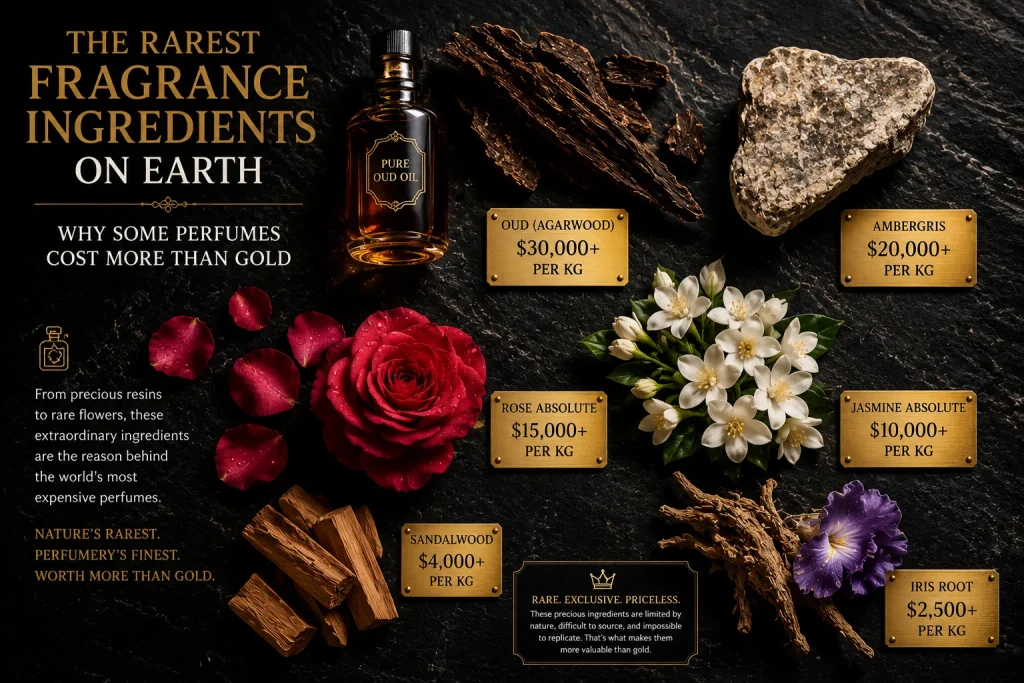
Gold is currently worth approximately $60 per gram. A gram of the highest quality aged oud oil from Bangladesh can cost between $5,000 and $10,000. A gram of pure natural ambergris, depending on grade and origin, sells for between $10,000 and $50,000. A kilogram of rose absolute from Grasse — the perfume capital of the world — costs upwards of $35,000.
The most extraordinary fragrance ingredients on earth are not just expensive. They are, by any objective measure, among the most expensive materials that exist anywhere in the world, in any category, for any purpose. More expensive than platinum. More expensive than saffron. More expensive, gram for gram, than most precious gemstones.
And they are expensive for reasons that go far beyond simple supply and demand. They are expensive because of what they are, where they come from, how they are obtained, and — in some cases — the extraordinary biological or geological processes that must occur over years or decades before they can exist at all.
This is the story of those ingredients. It is one of the most fascinating stories in the natural world.
Oud — the liquid gold of the fragrance world
Key cost drivers include tighter regulations on natural raw materials, higher tariffs on certain perfume ingredients such as rose, oud, and sandalwood, and increased compliance and sustainability reporting.
But these regulatory pressures are recent additions to a cost story that begins long before any government policy. The reason oud is extraordinarily expensive starts with biology — specifically, a biological accident.
Oud, also known as agarwood, comes from the Aquilaria tree, found primarily in Southeast Asia — Bangladesh, India, Cambodia, Vietnam, and Indonesia. The tree does not naturally produce oud. Oud only forms when the tree becomes infected by a specific mould — Phialophora parasitica — and responds to the infection by producing a dark, dense, intensely fragrant resin deep inside its heartwood. This resin, formed over years or decades as the tree fights the infection, is what oud is. The older the infection and the more the tree has struggled, the richer and more complex the resin.
Only approximately 2% of wild Aquilaria trees ever develop oud naturally. Wild trees capable of producing high-grade oud are now critically endangered across most of their natural range, with demand having stripped forests across Southeast Asia over decades of commercial harvesting. The trees that remain — and that carry the infection necessary for oud formation — are increasingly rare, increasingly protected, and increasingly expensive to access.
The grade of oud matters enormously in determining price. First-grade wild oud from Bangladesh — considered by perfumers and connoisseurs to be the finest in the world — can sell for between $5,000 and $10,000 per gram of pure oil. A single kilogram of this material, if it could be assembled, would represent a collection of liquid worth between five and ten million dollars.
The liquid inside the bottle often represents just a small fraction of the overall cost — only about 3% of the base price. But when oud is the liquid inside the bottle, this calculation changes completely. A fragrance built on genuine first-grade wild oud is not a product where the ingredients are an afterthought. The ingredient is the entire value proposition.
For Gulf buyers — where oud is not an exotic imported ingredient but a cultural heritage — the quality distinction between grades of oud is deeply understood and deeply felt. The difference between plantation-cultivated oud and genuine wild-harvested oud from aged trees is not subtle. It is the difference between something that smells like oud and something that smells like the history of oud.
Ambergris — the ocean’s most extraordinary accident
Ambergris is one of the strangest and most valuable materials in the natural world — and for most people, the story of what it is comes as a genuine surprise.
Ambergris is produced in the digestive system of sperm whales. When a sperm whale eats squid — its primary prey — the squid’s hard beaks cannot be digested. In some whales, these beaks accumulate in the intestine and the whale’s digestive system responds by coating them in a waxy, fatty substance. This substance — ambergris — builds up over years inside the whale, and is eventually expelled naturally or released when the whale dies.
When first produced, ambergris smells unpleasant — marine and fecal. But as it floats on the ocean surface and is exposed to sunlight, saltwater, and air for months or years, it undergoes a remarkable transformation. The unpleasant compounds oxidise and break down. What remains is a substance with one of the most extraordinary smells in the natural world — warm, sweet, earthy, slightly marine, deeply animalic in the best sense, with a quality that perfumers describe as almost impossible to replicate synthetically. It has a depth and a warmth and a skin-like intimacy that sets it entirely apart from any other fragrance material.
Ambergris also has a remarkable functional property: it is one of the most powerful fixatives in perfumery. A fixative is a substance that helps other fragrance compounds stay on the skin and last longer. Natural ambergris is so effective at this that a tiny amount — a few milligrams — can dramatically extend the longevity and projection of any fragrance it is combined with.
The price reflects both the rarity of the material and its functional value. High-grade ambergris — pale, aged, and fragrant — sells for between $10,000 and $50,000 per gram depending on origin, age, and grade. A piece of genuine silver or white ambergris weighing a kilogram, occasionally found washed up on beaches across the world, can be worth tens of millions of dollars.
Most modern perfumes use synthetic ambergris substitutes — Ambroxan being the most widely used and most commercially successful. Ambroxan is a molecule derived from a compound found in ambergris, produced synthetically at scale, and used in thousands of fragrances worldwide. It captures some of the warmth and skin-like quality of natural ambergris but lacks the full depth and complexity of the genuine material. Fragrances built on real ambergris are extraordinarily rare and extraordinarily expensive — which is precisely why they are so sought after by serious collectors and connoisseurs.
Rose absolute from Grasse — thousands of flowers for a single gram
The rose used in fine perfumery is not the rose in your garden. It is Rosa centifolia — the cabbage rose or May rose — grown almost exclusively in and around Grasse, in the hills above the French Riviera. And the economics of producing it are genuinely staggering.
It takes approximately 350 to 500 kilograms of rose petals to produce a single kilogram of rose absolute — the concentrated, solvent-extracted fragrance material that perfumers actually use in their formulas. The scarcity of certain natural raw materials such as jasmine absolute, vanilla, and patchouli, whose harvests are increasingly disrupted by climate change, is forcing perfumers to pay substantial premiums to secure their supplies.
In Grasse, where the microclimate, soil, and centuries of cultivation have produced what most perfumers consider the finest rose in the world, a kilogram of rose absolute now costs upwards of $35,000 and frequently more. The roses must be picked by hand, before sunrise, on the specific days in May and June when they reach peak fragrance intensity. They must be processed within hours of picking — the delicate fragrance compounds begin to degrade almost immediately after the flowers are cut. The work is entirely manual, entirely time-sensitive, and entirely irreplaceable by automation.
A perfume that genuinely contains natural Grasse rose absolute — not synthetic rose, not rose from a cheaper growing region, but genuine Grasse Rosa centifolia absolute — is wearing the work of hundreds of hours of human labour and thousands of flowers in every bottle. The price of such a fragrance is not a brand premium. It is a material reality.
The Turkish rose — Rosa damascena, grown in Bulgaria’s Rose Valley and in the Isparta region of Turkey — is a related but distinct material, similarly labour-intensive and similarly extraordinary. Bulgarian rose oil sells for between $4,000 and $8,000 per kilogram, making it less expensive than Grasse rose absolute but still among the most expensive agricultural products on earth by weight.
Jasmine absolute from Grasse — the night harvest
If rose is the queen of Grasse, jasmine is its most demanding resident. Jasmine absolute — specifically from Jasminum grandiflorum, cultivated in Grasse — is arguably the single most expensive agricultural fragrance ingredient produced in consistent commercial quantities anywhere in the world.
The harvest conditions are more demanding than almost any other crop. Jasmine flowers must be picked by hand, at night, during the brief window between sunset and sunrise when the flowers are fully open and their fragrance is at peak intensity. The flowers are so delicate that they begin to degrade immediately after picking and must be processed within hours. The yield is heartbreakingly small — it takes approximately 750 kilograms of jasmine flowers, all hand-picked in the dark, to produce a single kilogram of jasmine absolute.
A kilogram of genuine Grasse jasmine absolute costs between $40,000 and $60,000. Some years, when the harvest is poor, it costs more. The flowers are hand-picked by a dwindling workforce in a region where agricultural labour competes with the wages available in the broader French economy. Every factor that makes this ingredient extraordinary also makes it more expensive and harder to sustain year after year.
The result of this extraordinary material — when used by a skilled perfumer in a properly formulated fragrance — is a jasmine note with a depth, warmth, and complexity that no synthetic jasmine can fully replicate. Natural jasmine absolute contains over 200 distinct chemical compounds, many of which have never been isolated or reproduced synthetically. The synthetic versions capture the headline notes beautifully. They cannot capture the full orchestral complexity of the real thing.
Iris — the root of extraordinary patience
Iris absolute comes not from the iris flower but from its root — the rhizome — which must be cultivated for three years before harvest, then dried for a minimum of three additional years after harvesting before the fragrance compounds fully develop. From planting to finished fragrance material, iris requires a minimum of six years.
The fragrance compound produced by this patient process — irone — creates one of the most distinctive, most loved, and most complex notes in perfumery. Iris absolute smells powdery, cool, slightly woody, faintly carrot-like, and deeply sophisticated. It is one of the few fragrance materials that perfumers consistently describe as having an almost abstract quality — present without being obvious, beautiful without being immediately identifiable.
Brands also increasingly justify higher price points by emphasizing traceability, ethical sourcing, and “green chemistry” innovations, which translate into pricier, more limited runs of sustainable fragrances. Eco-certified natural isolates now account for roughly 18 to 24 percent of premium fragrance formulas, up from under 10 percent in 2019. Iris grown in the Chianti region of Tuscany — considered the finest in the world — is now increasingly certified and traceable, which adds to both its ethical credibility and its cost. A kilogram of high-grade natural iris absolute costs between $40,000 and $100,000, making it one of the most expensive materials in the entire fragrance industry.
Sandalwood — the slow-growing forest luxury
Mysore sandalwood from Karnataka, India — considered the finest sandalwood in the world — is one of the most controlled and most coveted fragrance raw materials that exists. The trees must grow for a minimum of 30 years before their heartwood develops the rich, creamy, warm fragrance compounds that make Mysore sandalwood irreplaceable in fine perfumery. The Indian government strictly controls its harvest. Wild trees are protected. Supply is managed through a government monopoly that allows only limited quantities to reach the international market each year.
The result of this supply restriction on a material with global demand is prices that consistently exceed $3,000 to $5,000 per kilogram of oil and continue to rise. Australian sandalwood — Santalum spicatum — is a more commercially available alternative, with Hawaiian sandalwood — Santalum paniculatum — occupying the highest price tier among cultivated varieties. None of them fully replicate the specific creamy, milky, deeply warm quality of genuine old-growth Mysore sandalwood, which perfumers describe as irreplaceable.
Tuberose absolute — the white flower that exhausts
Tuberose absolute is produced from the flowers of Polianthes tuberosa — a white, intensely fragrant flower native to Mexico and widely cultivated in India and France. The flowers are extraordinarily rich in fragrance — the scent is heavy, narcotic, creamy, and complex, with a depth that makes it one of the most used and most loved note families in fine perfumery.
The production economics are brutal. Tuberose flowers must be picked by hand when fully open. The enfleurage method — immersing the flowers in fat to allow the fragrance to transfer — is still used for the finest tuberose absolute, as it preserves delicate fragrance compounds that solvent extraction destroys. A kilogram of tuberose absolute produced by enfleurage costs between $3,000 and $6,000 and requires a quantity of flowers that represents days of manual picking labour.
What all of this means for the fragrance you choose to wear
The existence of these extraordinary materials — and the extraordinary prices they command — reveals something genuinely important about the fragrance industry and about what you are actually paying for when you invest in a serious fragrance.
When it comes to high-end perfumes, the liquid inside the bottle often represents just a small fraction of the overall cost — only about 3% of the base price. Packaging, on the other hand, can account for 10 to 20 percent. The rest often goes toward marketing, celebrity endorsements, and the allure of the brand itself. This is the truth about most luxury fragrance spending — and it is a truth worth knowing.
But the existence of fragrances built on genuine wild oud, real ambergris, authentic Grasse rose or jasmine, aged iris, or old-growth Mysore sandalwood represents something categorically different. These are not fragrances where you are paying for marketing. You are paying for materials that are genuinely extraordinary — that took years or decades to form, that required hundreds of hours of human labour to harvest, and that contain chemical complexity no laboratory has yet been able to fully replicate.
Despite rising prices, high-end fragrance remains one of the most accessible entry points into luxury. Compared to fine jewelry, couture fashion, or watches, a $300 bottle of perfume offers months — sometimes years — of daily indulgence. For younger buyers especially, fragrance delivers status and sophistication without requiring a five-figure investment.
The informed fragrance buyer in 2026 understands this distinction. They know the difference between a price that reflects genuine material rarity and one that reflects brand engineering. They know that a well-made affordable fragrance using high-quality synthetic materials can outperform an expensive bottle of mediocre naturals. And they know that the very finest fragrances — the ones built on the rarest ingredients the earth produces — represent something genuinely irreplaceable.
At Precious Scent, our collection of long lasting fragrance, luxury fragrance, and affordable fragrance is curated with this understanding at its foundation. Whether you are looking for the best fragrance for men that honours the oud tradition with genuine quality, the best fragrance for women that captures the depth of rare florals in a beautifully crafted composition, or simply the best scents that deliver real performance and real value at every price point — the collection is here, authentic and chosen with the kind of knowledge that rare ingredients deserve.
The earth produces extraordinary things. The finest fragrances are made from them. And wearing something built on these materials — even a small amount of genuine oud, real rose absolute, or authentic sandalwood — is wearing a piece of the natural world that took years to become what it is.
That is worth knowing. And worth experiencing.