

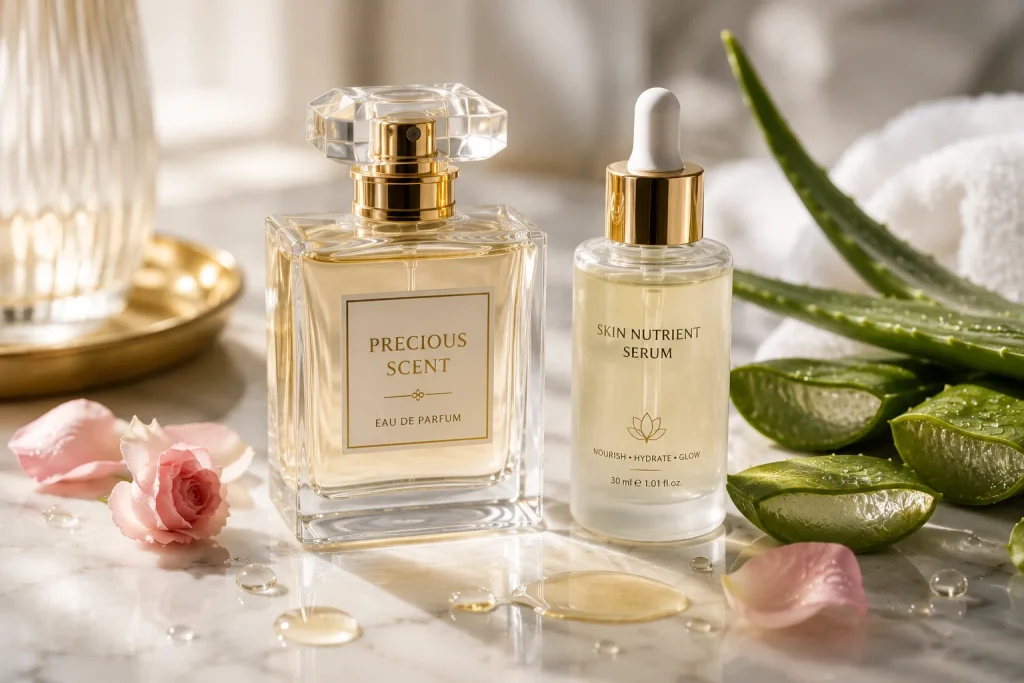
There is a question that almost nobody asks when they buy perfume: what is this doing to my skin?
Most people think about fragrance purely in terms of what it does in the air — how it smells, how far it projects, how long it lasts. The skin is just the delivery mechanism. You spray the fragrance onto it, it does its job as a surface, and the conversation ends there.
In 2026, the fragrance industry is completely rethinking this relationship. And what is emerging — the crossover between perfume and skincare — is one of the most genuinely interesting and practically significant developments in the history of modern fragrance.
Here is what is happening, why it matters, and what it means specifically for buyers in the UAE.
The skin-ification of fragrance — what it actually means
In 2026, fragrance is continuing to move closer to skincare, with the ongoing skin-ification of scent and the introduction of hydrating and skin-benefiting properties, according to DSM-Firmenich Fragrance Developmental Manager Rachael Larsen.
Skin-ification is the term the beauty industry uses to describe products from other categories — makeup, haircare, body care — that are being reformulated to include active skincare ingredients and benefits. It has already transformed lipstick, foundation, and body lotion. Now it is transforming perfume.
The basic idea is straightforward: instead of simply applying fragrance to skin and expecting the skin to do the work of holding and projecting the scent, new-generation fragrances are being designed to actively work with skin — hydrating it, improving its barrier function, and creating a better surface for the fragrance itself to perform on.
The implications of this are more significant than they might sound at first. If you have ever struggled with fragrance longevity — if your perfume disappears within two hours despite expensive bottles and EDP concentrations — dry, compromised skin is very often the reason. Skin that is well-hydrated and barrier-healthy holds fragrance molecules for significantly longer, projects them more evenly, and allows the full note pyramid to develop as the perfumer intended. Skin-ification means the fragrance itself is now doing some of the work of preparation that previously fell entirely to the wearer.
The specific innovations leading this change
This is not just a marketing direction. Specific, technically significant product innovations are driving the skin-ification of fragrance in 2026 — and several of them are remarkable.
Estée Lauder Companies, in partnership with technology start-up Exuud, developed a smart fragrance delivery system that releases aromatic molecules in controlled bursts, preserving the scent’s delicate top notes and preventing olfactory desensitization — the phenomenon where you stop smelling your own fragrance after wearing it for a while. This is a genuine technical breakthrough. Olfactory desensitization — your brain tuning out a familiar smell — is one of the main reasons people over-spray. A controlled-release system that refreshes the scent in micro-bursts throughout the day eliminates the problem at the source.
Vexa launched a peptide-enhanced perfume — a fragrance formulated with skin-active peptide compounds that deliver skincare benefits while the scent is worn. Peptides are among the most clinically validated ingredients in skincare, associated with collagen support, skin repair, and barrier strengthening. A fragrance that includes them is not just smelling good. It is, in a small but real sense, treating the skin it is applied to.
Bella Hadid’s alcohol-free, bi-phase fragrance line Orebella combines skincare benefits with fragrance — a formulation approach that is growing rapidly as buyers seek products that are gentler on skin and more aligned with their overall skincare philosophy.
And Rare Beauty’s debut perfume features 12-hour longevity and a bottle ergonomically designed in partnership with certified hand therapists for greater accessibility — a different dimension of skin-ification that focuses on how the product physically interacts with the body rather than its chemical formulation.
Why alcohol-free fragrance matters — especially in Dubai
One of the most practically significant dimensions of the skin-ification trend is the rapid growth of alcohol-free fragrance formats. Traditional perfume uses alcohol as its primary carrier — it is what allows the fragrance to disperse into the air and evaporate off the skin. But alcohol also has significant drawbacks, particularly for skin health.
Alcohol is drying. Regular daily application of alcohol-based fragrance to sensitive or dry skin can contribute to dehydration, barrier disruption, and in some people, visible irritation over time. For buyers who apply perfume every day — which is essentially all serious fragrance wearers — this is a genuine consideration.
Alcohol-free fragrances use alternative carrier systems — typically oil-based, water-based, or bi-phase formulations — that deliver scent without the drying effect. They tend to sit closer to skin, project more intimately, and interact differently with body chemistry. The sillage is generally softer and more personal — less of a broadcast, more of a conversation.
For UAE buyers specifically, the alcohol-free format has particular relevance. In Dubai’s heat, alcohol-based fragrances evaporate extremely fast — the carrier alcohol essentially drives the top notes off the skin at accelerated speed before the base notes can properly anchor. An oil-based or alcohol-free format evaporates far more slowly, allowing the fragrance to develop through its full note structure even in extreme temperatures. This makes alcohol-free fragrance one of the most practically effective long lasting fragrance formats available for hot weather wear.
There is also a cultural dimension. For some buyers in the UAE and broader Gulf region, reducing alcohol content in personal care products is a genuine preference. The growth of high-quality alcohol-free fragrance options addresses this directly — and the category has improved dramatically in recent years, with formats that match the performance of traditional EDPs rather than compromising on it.
The skin-close scent movement — fragrance as a second skin
Connected to skin-ification but slightly different is what experts are calling the skin-close scent movement — fragrance that feels like an extension of the wearer rather than something worn on top, according to Almira Armstrong, founder of Atelier Lumira.
The traditional model of fragrance is projection — the idea that a great perfume announces itself, fills a room, leaves a trail. The skin-close movement represents a deliberate move away from this toward intimacy. These fragrances are designed to sit on the skin rather than radiate off it. They are smelled by the person standing close to you, not the person passing you in a corridor.
The notes that characterise skin-close fragrances are soft musks, warm ambers, vanilla and skin accords — ingredients that warm with body heat and become personal rather than public. Commodity’s Milk is described as creamy and warm, sweet but cool, with a musk base that softens against skin for a subtle but chic signature. This is the aesthetic of skin-close fragrance: present without announcing, intimate without being invisible.
For Dubai buyers this approach offers something genuinely useful. In a city where the social and professional contexts shift constantly — from outdoor heat to close air-conditioned environments, from formal business settings to intimate social gatherings — a skin-close fragrance performs consistently across all of them. It is never too much in a meeting room. It is always enough in a private conversation.
What the wellness dimension adds to all of this
Underlying the entire skin-ification movement is a broader shift in how fragrance is understood philosophically. The Future Laboratory’s 2026 forecast notes that innovations signal a decisive break from fragrance as a fixed identity marker toward products that respond, adapt, and perform — with fragrance evolving from a static accessory into a living, personalized experience.
The language here is significant. Fragrance as a living experience. As something that responds to the body rather than being applied to it. This is genuinely different from how perfume has been conceived and marketed for most of its modern history — and it represents a meaningful shift in what buyers are being offered and what they are starting to expect.
Wellness-conscious perfumes — with alcohol-free, skin-friendly, and responsibly sourced formulations — are on the rise, designed to support mood, mindfulness, and overall well-being, not just scent, according to DSM-Firmenich Principal Perfumer Frank Voelkl.
For UAE buyers, who are among the most sophisticated and most demanding fragrance consumers in the world, this wellness dimension adds a genuinely new layer of value to the buying decision. A fragrance that smells extraordinary and actively supports skin health is a different proposition from one that simply smells extraordinary. It is a proposition that deserves attention.
What this means practically for how you buy fragrance right now
The skin-ification of fragrance is not yet universal. Most fragrances on the market are still formulated traditionally. But the direction is clear and the innovation is accelerating — which means buyers who understand what is changing can make better decisions right now, even before the mainstream catches up.
When evaluating fragrances, consider not just how they smell but how they interact with your skin. Does this formula dry your skin over time? Is there an alcohol-free version available? Does the fragrance include any skin-active ingredients — hyaluronic acid, peptides, botanical extracts — that add genuine value beyond the scent?
Consider oil-based formats and alcohol-free options seriously — particularly for daily wear in Dubai’s heat. The longevity and skin-compatibility advantages are real and practically significant in the UAE climate.
And pay attention to how a fragrance sits on your skin specifically — whether it projects or stays close, whether it dries your skin over hours of wear, and whether it still smells true to itself at the end of a long Dubai day or has become something unrecognisable as it reacts with your skin’s changing chemistry.
At Precious Scent, we are watching the skin-ification movement with genuine interest — because it aligns directly with what we have always believed about great fragrance: that it should work with your body rather than simply on it. Our collection of long lasting fragrance, luxury fragrance, and affordable fragrance is curated with UAE skin and climate in mind — and as skin-compatible, alcohol-free, and wellness-aligned options continue to develop, we bring them to UAE buyers as soon as they meet our standards for genuine quality and performance. Whether you are looking for the best fragrance for men or best fragrance for women that performs as beautifully on your skin as it does in the air — that is exactly what Precious Scent is here to help you find.