
Why Pepper Is Suddenly Making Fragrance Smell More Interesting in Fall 2026
For years, autumn fragrance had a fairly predictable script. Vanilla...
Read More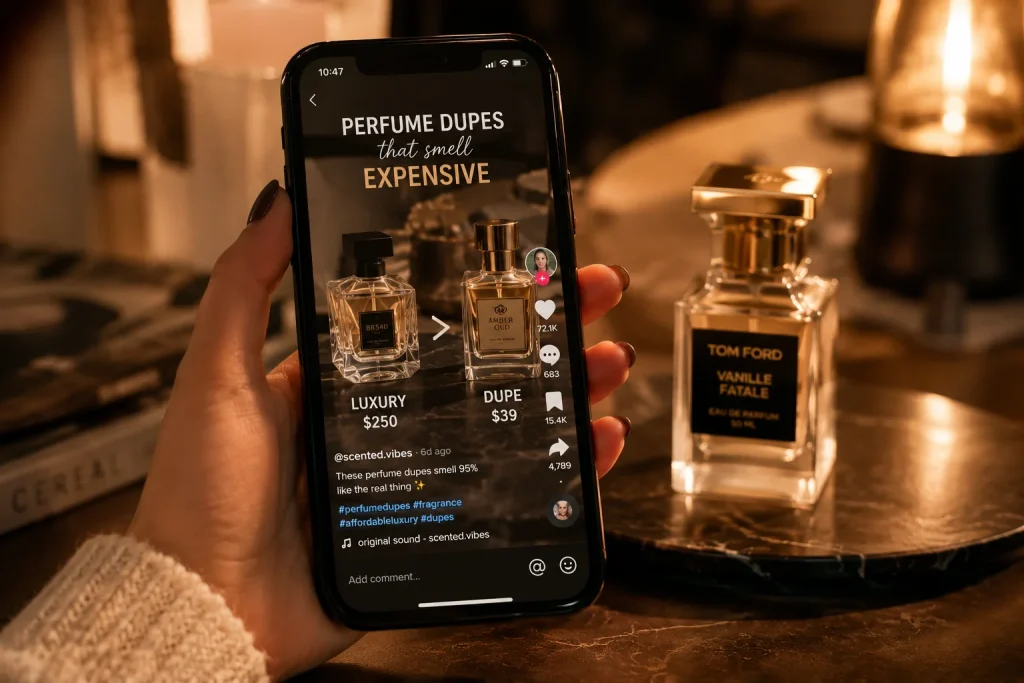
The word “dupe” has taken over the fragrance internet.
TikTok perfume dupe searches exploded globally, with creators building entire channels around finding budget alternatives to expensive fragrances — and the concept has fundamentally changed how millions of people think about buying perfume.
Type any luxury fragrance name into TikTok right now and within seconds you will find dozens of videos promising the perfect dupe — a bottle that smells identical, costs a fraction of the price, and makes you wonder why anyone would ever buy the original again. The comment sections are full of people sharing their own discoveries, debating which dupe is closest, and congratulating themselves on outsmarting the luxury fragrance industry.
It is genuinely compelling content. It is also, in many important ways, deeply misleading. And understanding what is actually true about fragrance dupes — what they are, how they work, what they can and cannot deliver, and when they make sense versus when they absolutely do not — is one of the most valuable pieces of fragrance knowledge you can have in 2026.
This is the complete, honest guide. No agenda. No brand protection. Just the truth about dupes — all of it.
A fragrance dupe is a product created to approximate the scent of another, usually more expensive fragrance. The dupe does not contain the same formula as the original. It does not use the same ingredients. It is a separate product, created by a separate manufacturer, designed to remind people of the original when they smell it.
This distinction matters enormously and is consistently glossed over in dupe content. any TikTok-famous perfumes are worth trying because they offer great scent quality and performance. However, fragrance is personal, so it’s always a good idea to test a sample before purchasing a full bottle.
The reason it matters is this: a fragrance dupe is not a copy. It is an approximation — an attempt to create a similar olfactory impression using different, usually less expensive ingredients. The similarity is real in some cases. The identity is never real. And the difference between similarity and identity in fragrance is not a minor technical detail. It is the entire story.
When someone says a dupe smells “identical” to the original, they mean it smells similar to them, in the first five minutes, in the specific conditions in which they tested it. What they do not know — because most dupe content never tests for this — is how the two fragrances compare in longevity, in the dry-down phase, on skin that is warm rather than cool, in heat rather than temperate conditions, and over the course of a full day rather than a thirty-second sniff.
Consumer behaviour around perfume has fundamentally changed. People no longer search for brand names first. They search for scent profiles.
This shift toward scent-profile searching is actually what makes dupe culture possible in the first place. When people know they love warm amber and vanilla, they can search for that profile at any price point. And they will find products that deliver that profile at significantly lower prices than the luxury original.
But the specific way a fragrance expresses any note profile is determined by its exact formula — the specific molecules used, their concentrations, the supporting accords that give the composition depth and complexity, and the quality of the raw materials involved. These are not interchangeable. A cheaper synthetic molecule that approximates the amber accord of the original will behave differently on skin, evaporate at a different rate, and interact with body chemistry in a different way.
Floral notes are going deep and rich blended with notes like woods and ambers — and this depth is precisely what differentiates the finest fragrances from their approximations. The best fragrances are built on layers of complexity that reveal themselves slowly over hours of wear. A dupe typically captures the headline notes — the immediately recognisable impression — while lacking the supporting structure that makes the original develop beautifully over time.
This is why dupe content almost always focuses on the opening. Because that is where the similarity is strongest and most convincing. And because nobody is making a fifteen-hour TikTok video documenting what a fragrance smells like at the twelve-hour mark on warm skin after a busy day.
Here is where this guide differs from most fragrance content: dupes are not always wrong. There are specific situations where a well-chosen dupe is the genuinely intelligent decision.
If you are curious about whether you love warm amber and vanilla as a fragrance direction — whether it suits your skin, your lifestyle, and your preference — buying an affordable approximation to test the territory before committing to a premium bottle is entirely sensible.We are officially in the era of the fragrance wardrobe, where consumers curate collections of 8 to 12 different scents to match specific moods.Testing fragrance directions with accessible options before committing to luxury is smart wardrobe building, not compromise.
A Tuesday morning commute in a casual environment is not the same occasion as a Friday evening dinner or a significant social event. If you want warm vanilla and amber on a casual Tuesday and you own both an original and an approximation, wearing the approximation on the casual Tuesday and the original when it matters is sensible fragrance wardrobe management.
Some of the best affordable TikTok perfumes include Lattafa Khamrah, Yara by Lattafa, Eclaire by Lattafa, and Club de Nuit Intense Man. These fragrances are popular because they deliver excellent value for money.
Here is the important nuance: some of these products are not really dupes at all. They are genuinely excellent affordable fragrance options that happen to share note profiles with more expensive fragrances. Lattafa Khamrah is not primarily valuable because it approximates something else. It is valuable because it is a genuinely well-made warm oriental fragrance that performs exceptionally well and smells extraordinary in its own right. Calling it a dupe of something more expensive undersells what it actually is.
This distinction — between a product that is genuinely excellent at an accessible price and a product that is primarily constructed to approximate something more expensive — is one the dupe conversation consistently fails to make. And it matters, because it determines what standard you are holding the product to and what satisfaction you should expect from wearing it.
There are specific situations where pursuing a dupe is the wrong decision — and where the money saved on the bottle is actually spent in disappointment, in skin reactions, and in the gap between what you wanted and what you received.
If you need a long lasting fragrance that performs through a full day in warm conditions — which describes most buyers in Dubai and the UAE — a dupe is consistently the wrong choice. The longevity of a fragrance is primarily determined by the quality and concentration of its base note materials. The molecules that create lasting performance in premium fragrances — genuine musk, quality oud, real amber — are expensive. Dupes use cheaper alternatives that approximate the smell but not the staying power.
Much of this momentum lives on social media, where #PerfumeTok has surpassed 6.4 billion views, turning trending perfumes into instant sell-outs before they even reach department store shelves. But what social media does not show you is the two-hour longevity test that reveals the true performance gap between a premium original and its approximation. Nobody makes that video because it is not flattering to the dupe and it kills the engagement.
This is the most important practical concern about dupes that almost nobody discusses. Premium fragrance manufacturers operate under strict regulatory frameworks — IFRA guidelines — that control the concentration of potential allergens in fragrance formulas. Every ingredient in a premium fragrance has been tested and approved within regulated limits.
Dupe manufacturers, particularly those producing at very low price points, operate with significantly less regulatory scrutiny. The molecules they use to approximate expensive natural ingredients are often cheaper synthetics in higher concentrations — because higher concentration is the only way to achieve similar projection at a lower material cost. These higher concentrations of cheaper synthetics are associated with higher rates of skin sensitivity reactions, contact dermatitis, and in some cases more serious allergic responses.
This is not theoretical. It is a documented pattern across fragrance safety research. The skin you are applying fragrance to every day deserves the protection of properly regulated ingredients.
Instead of one expensive designer bottle, two quality EDP fragrances from a formula-first brand at equivalent cost creates a personalised stacking wardrobe with more olfactory variety.
There is a category of fragrance — not all expensive fragrances, but a specific subset — where the original is genuinely, materially better than any approximation because its quality cannot be replicated at a lower price point. Fragrances built on genuine rose absolute, real oud, aged sandalwood, or rare naturals fall into this category. The reason these fragrances cost what they cost is not primarily marketing. It is material. The ingredients are genuinely rare, genuinely expensive, and genuinely irreplaceable by synthetic alternatives.
A dupe of a fragrance built on these materials does not capture what makes the original worth experiencing. It captures the general direction. It misses the depth, the complexity, and the specific way those rare natural materials interact with body chemistry over hours of wear. For fragrances in this category, the dupe is not a smart alternative. It is a category error.
By 2026, the fragrance industry is undergoing a structural shift. Consumer demand is moving beyond “smells good” toward emotionally resonant, high-performing, and personally meaningful fragrance experiences.
This shift is changing what dupe culture actually means. The original dupe conversation was about access — people who could not afford luxury fragrances finding cheaper alternatives. In 2026, it is increasingly about something different: the recognition that price is not the primary indicator of quality, and that genuinely excellent fragrance is available across a wide range of price points.
The days of everyone wearing the same handful of body sprays from the local chemist are long gone. Your scent now says as much about you as your outfit, on social media and in real life.
The most sophisticated buyers in 2026 are not choosing between expensive originals and cheap dupes. They are building deliberate collections — some premium, some accessible — where every choice is made on the basis of genuine quality and genuine performance rather than brand prestige or viral recommendation.
Many creators use it as a base fragrance and combine it with other perfumes — the scent stacking approach that is defining 2026 fragrance culture. This is the intelligent evolution of the dupe conversation — not “how do I smell like the expensive thing for less money” but “how do I build a collection of genuinely excellent fragrances at the price points that make sense for my life.”
At Precious Scent — the best fragrance store in Dubai — we do not stock dupes. We stock genuine, authentic fragrance products across a wide range of price points — from genuinely excellent affordable fragrance options that stand completely on their own merits to the finest luxury fragrance pieces that justify every dirham of their price.
The distinction matters to us because authenticity is the foundation of everything we do. Every product in our collection is exactly what it says it is — sourced through verified supply chains, with complete traceability, and with the performance characteristics of a genuine product rather than an approximation.
What we have found — and what our customers consistently discover — is that the question is never really “dupe or original.” It is “genuine quality at what price point?” And genuine quality, at Precious Scent, is available across the full range.
Our affordable fragrance collection includes products that are genuinely excellent — not because they approximate something more expensive, but because they are brilliantly formulated fragrances in their own right. Products like Lattafa Khamrah — warm, spiced, deeply performant — are not valuable because they remind people of something else. They are valuable because they are extraordinary on their own terms.
Our luxury fragrance collection includes products whose price is genuinely justified by the quality of their ingredients and the sophistication of their composition — fragrances where the investment delivers something that no approximation can replicate.
And across both — across every long lasting fragrance, every best fragrance for men, every best fragrance for women, every selection in our curated best scents collection — the standard is identical: genuine quality, genuine performance, genuine authenticity.
Scent now says as much about you as your outfit, on social media and in real life. What it says should be something true — something genuinely you, genuinely excellent, genuinely worth the investment you made in it.
At Precious Scent, that is all we sell.
For years, autumn fragrance had a fairly predictable script. Vanilla...
Read MoreThere was a time when wearing a fragrance meant making...
Read MoreFor decades the advice was unanimous. Find your signature scent....
Read MoreThere was a time when people wanted to smell like...
Read More