

Introduction
Have you ever reached the end of the day feeling completely exhausted, even though you barely did any physical work?
You didn’t go to the gym.
You didn’t spend hours doing hard labor.
You may have spent most of the day sitting, scrolling on your phone, checking emails, watching videos, or simply moving between small everyday tasks.
Yet somehow, your mind feels drained.
This has become one of the most common modern-day experiences around the world, and surprisingly, science explains exactly why it happens.
The truth is simple.
Your brain is working far harder than most people realize, even when your body is doing almost nothing.
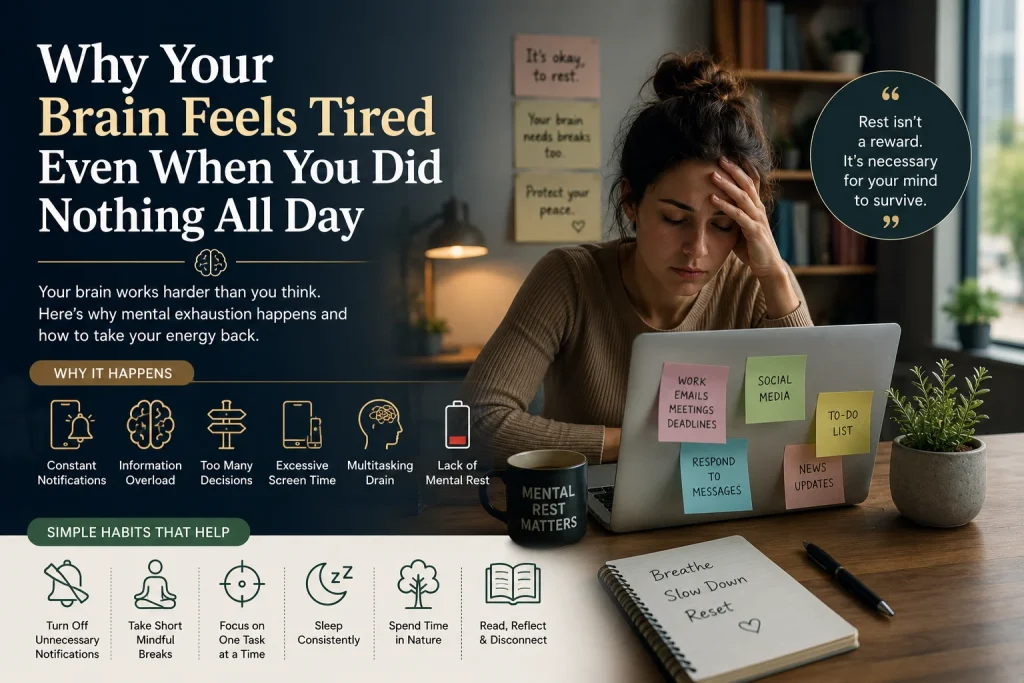
The Modern World Is Overloading Your Brain
Unlike previous generations, modern humans process an enormous amount of information every single day.
The average person now consumes more information in one day than people several decades ago processed in weeks.
Think about how many things your brain handles daily:
- Phone notifications
- Social media scrolling
- Work messages
- Emails
- Conversations
- Videos
- Music
- Decision making
- News consumption
- Endless online content
Your brain rarely gets true quiet time anymore.
Even when you feel like you are “doing nothing,” your mind is often processing hundreds of small inputs continuously.
This creates mental fatigue.
Decision Fatigue Is Real
One major reason people feel mentally exhausted is something psychologists call decision fatigue.
Every single day your brain makes thousands of decisions.
Simple examples include:
- What time should I wake up?
- What should I wear?
- What should I eat?
- Should I reply now or later?
- Which message is more important?
- Should I work or rest first?
- What should I watch tonight?
Individually, these decisions feel small.
But together they slowly drain mental energy.
By evening, your brain may feel tired even if your body feels perfectly fine.
Constant Screen Time Never Lets Your Mind Rest
Many people assume rest means sitting on the couch and scrolling through their phones.
But your brain sees this differently.
When you scroll through social media, your brain constantly processes:
- New images
- New emotions
- Comparisons with other people
- Fast-changing information
- Short attention shifts
- Dopamine responses
Your mind stays highly active.
This means your “rest time” often isn’t actual rest at all.
In some cases, excessive screen time can leave you feeling even more mentally exhausted.
Multitasking Is Secretly Draining You
People often believe multitasking makes them productive.
But neuroscience says otherwise.
Switching rapidly between tasks forces your brain to constantly reset.
For example:
- Replying to messages while working
- Watching videos while eating
- Checking notifications while studying
- Listening to podcasts while answering emails
Every switch uses mental energy.
The more you multitask, the faster your brain becomes tired.
Your Brain Needs Recovery Time
Most people focus on physical recovery.
They understand the importance of sleep after exercise.
But very few people think about mental recovery.
Your brain also needs downtime.
True recovery happens when you spend time doing activities like:
- Walking without your phone
- Reading quietly
- Sitting in silence
- Spending time in nature
- Deep sleep
- Meditation
- Simple hobbies without screens
Without recovery periods, mental fatigue builds every day.
Why You Feel Unmotivated Sometimes
Many people think feeling mentally tired means they are lazy.
That is often not true.
Sometimes your brain simply reaches overload.
When cognitive overload happens, motivation naturally decreases.
Tasks begin to feel heavier.
Concentration becomes harder.
Even small responsibilities feel frustrating.
This doesn’t necessarily mean you lack discipline.
Sometimes your brain is simply asking for recovery.
The Hidden Impact of Modern Convenience
Technology has made life easier physically.
But mentally, life has become far more demanding.
Previous generations worried about survival and physical labor.
Modern humans deal with constant mental stimulation.
We live in an environment where our attention is being pulled in hundreds of directions every day.
This constant stimulation creates invisible exhaustion.
The body may feel rested.
The brain may feel overwhelmed.
Small Habits That Help Reduce Mental Exhaustion
The solution isn’t quitting technology.
Small changes can help significantly.
Try these habits:
1. Reduce unnecessary notifications
Turn off alerts that do not require immediate attention.
2. Take short screen-free breaks
Even 15 minutes away from screens helps.
3. Stop multitasking
Focus on one task at a time.
4. Sleep consistently
Your brain performs recovery during deep sleep.
5. Protect quiet time
Allow your mind moments without stimulation.
6. Spend time outdoors
Natural environments help lower mental fatigue.
Final Thoughts
One of the biggest misconceptions today is believing physical inactivity means true rest.
In reality, modern life keeps our brains working constantly.
If you feel tired even after doing “nothing all day,” there is a good chance your mind has been overloaded by nonstop information, decisions, and digital stimulation.
Your body and brain experience fatigue differently.
And sometimes, the most productive thing you can do is simply allow your mind to recover.
In a world where attention is constantly being demanded, protecting your mental energy may become one of the most important life skills of the modern age.