
How Fragrance Is Made — The Complete Journey From Ingredient to Bottle
Introduction Have you ever picked up a bottle of perfume...
Read More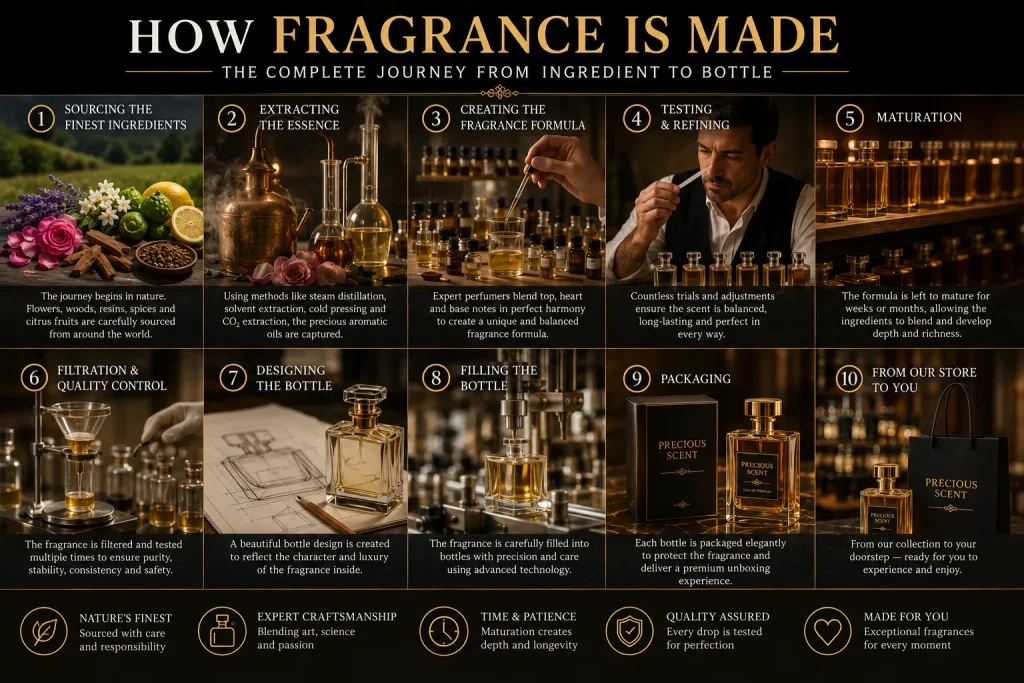
Introduction
Have you ever picked up a bottle of perfume and wondered what it took to create that beautiful scent?
Behind every fragrance lies a fascinating journey that combines nature, science, creativity, and craftsmanship. A single bottle may contain dozens—or even hundreds—of carefully blended ingredients sourced from different parts of the world.
From blooming flowers harvested before sunrise to precious oud wood aged for years, every ingredient plays an important role in creating the final fragrance.
Whether you’re shopping for luxury perfumes, searching for long lasting perfumes, or looking for affordable perfumes, understanding how fragrance is made helps you appreciate the artistry behind every spray.
Let’s explore the complete journey of a perfume—from raw ingredients to the bottle on your shelf.
Every great fragrance starts with high-quality raw materials.
Perfumers use both natural and synthetic ingredients to achieve the perfect balance between beauty, longevity, and consistency.
Some of the most popular natural perfume ingredients include:
These ingredients are sourced from different regions around the world depending on where they grow best.
For example:
Because many natural ingredients are seasonal and difficult to harvest, they contribute to the value of premium fragrances.
Once ingredients are collected, their aromatic oils must be extracted.
Different ingredients require different extraction methods.
Steam passes through flowers, herbs, or woods, carrying fragrant oils that are later separated from water.
This method is commonly used for lavender, eucalyptus, and rosemary.
Delicate flowers such as jasmine cannot tolerate high temperatures.
Instead, gentle solvents are used to capture their fragrance without damaging the scent.
Citrus fruits like oranges, lemons, and bergamot release their oils when their peels are pressed.
This preserves their bright and refreshing aroma.
One of the most advanced extraction methods uses pressurized carbon dioxide to produce extremely pure fragrance oils while preserving delicate scent molecules.
This is where creativity truly begins.
Professional perfumers—often called “noses”—carefully blend ingredients to create a balanced composition.
A perfume is usually built around three layers known as fragrance notes.
These are the first scents you notice immediately after spraying.
Common top notes include:
They create a fresh first impression but fade relatively quickly.
As the top notes disappear, the heart of the fragrance begins to develop.
Popular heart notes include:
These notes define the perfume’s character.
The final stage appears after several hours.
Base notes provide depth, warmth, and longevity.
Examples include:
These ingredients help create the long lasting perfumes many fragrance lovers seek.
Creating a successful perfume rarely happens on the first attempt.
Perfumers test countless variations before selecting the final formula.
They evaluate:
Even tiny adjustments—sometimes less than one percent—can dramatically change how a fragrance smells.
Some perfumes require months or even years of development before they are ready for release.
After blending, the fragrance is not bottled immediately.
Instead, it is allowed to mature.
During maturation, the ingredients naturally blend together, creating a smoother and more harmonious scent.
This process can last several weeks or even months depending on the fragrance.
Just like fine wine, some perfumes become better with patience.
Before bottling, the perfume undergoes filtration to remove any unwanted particles.
Every batch is carefully inspected to ensure:
Luxury fragrance houses maintain strict quality standards because customers expect every bottle to smell exactly the same.
The bottle is often the first thing customers notice.
Luxury perfume brands invest heavily in elegant packaging that reflects the fragrance inside.
Design teams carefully choose:
A beautiful presentation enhances the overall fragrance experience.
Modern production lines fill each bottle with precision.
After filling, bottles receive:
Only after passing final checks are they shipped to retailers around the world.
Many people believe all perfumes should contain only natural ingredients.
In reality, modern perfumery combines both natural and synthetic materials.
Synthetic ingredients help:
The best perfumes often combine both to achieve outstanding performance.
Several factors influence perfume pricing.
These include:
This is why luxury perfumes often command higher prices.
However, many affordable perfumes now offer impressive quality thanks to modern fragrance technology.
Price alone doesn’t determine how enjoyable a perfume will be.
At Precious Scent, fragrance lovers can explore a carefully selected collection of authentic perfumes from internationally recognized brands.
Whether you’re searching for the best perfumes for men, best perfumes for women, long lasting perfumes, or premium luxury perfumes, understanding how fragrances are made makes choosing your next scent even more rewarding.
Every bottle tells a story—from the fields where ingredients are grown to the craftsmanship that transforms them into unforgettable fragrances.
Creating a perfume is far more than simply mixing pleasant scents.
It is a remarkable process that combines nature, chemistry, artistry, and innovation.
From carefully harvesting rare ingredients to designing elegant bottles, every step contributes to the final fragrance experience.
The next time you spray your favorite perfume, remember the incredible journey it has taken—from ingredient to bottle.
That journey is what makes every fragrance truly special.
Introduction Have you ever picked up a bottle of perfume...
Read MoreGold is currently worth approximately $60 per gram. A gram...
Read MoreIntroduction Have you noticed that your favorite perfume costs significantly...
Read MoreThe moment you walk into a great hotel lobby, something...
Read More